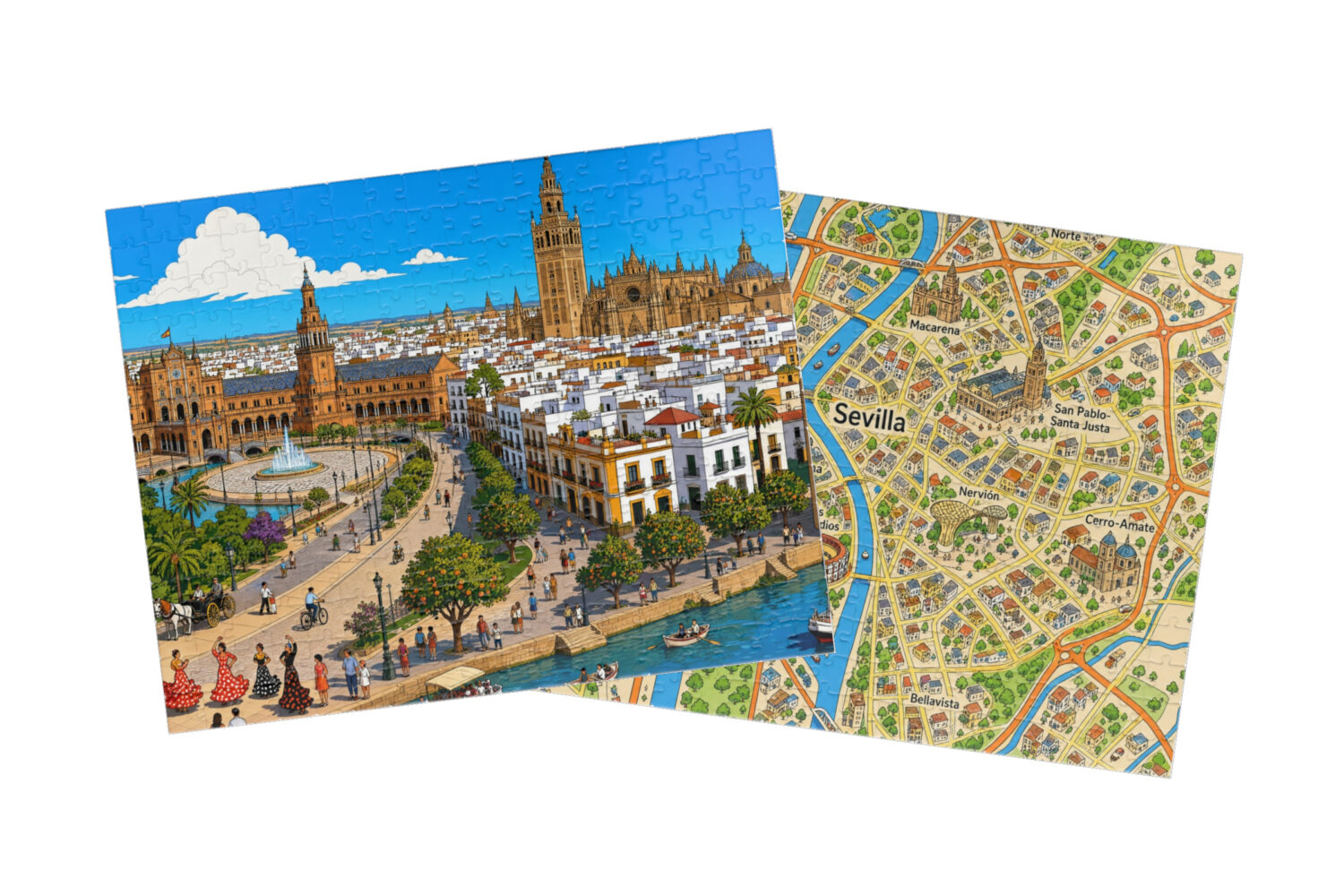
A ship has returned to Sevilla after sailing around the world. A stranger offers its secrets for sale, but apprentice mapmaker Inés notices a missing day. Ronald, Tony, Karen and Harly follow a stolen notebook through the riverfront streets, where the strangest clue may be true.
Behind the adventure
Inés, Alonso, the seller, the theft, notebook and pursuit are fictional. The unnamed mariner is a composite dramatic representative of the returning crew, not an additional documented survivor or a portrait of a named individual. His notebook and daughter’s drawing are invented and are not Pigafetta’s surviving manuscript. Recurring characters appear as imagined visitors to the past. Dialogue is in English for readers. Streets, routes and workshop are simplified fictional staging.
Victoria completed the first circumnavigation under Juan Sebastián Elcano in 1522, returning to Sanlúcar on 6 September and Sevilla on 8 September. Five ships had departed in 1519; only Victoria completed the circuit. The expedition had already discovered its one-day calendar discrepancy at Cape Verde in July 1522, as recorded by Antonio Pigafetta. The fictional Sevilla investigation revisits that known discrepancy; it does not move its historical discovery to Sevilla. Westward travel lengthened the travellers’ local solar days, producing one fewer counted day over a full circuit compared with those who stayed home. The Giralda’s later Renaissance summit, the modern iron Triana bridge and Torre del Oro’s eighteenth-century upper turret are omitted. Spanish Ministry of Culture: first circumnavigation records.
Ronald & Tony
The secret of Sevilla

© 2026 Learner Bros AB. All rights reserved.
Get the puzzle Free shipping